Grief & Loss
The Things We Keep After Someone Dies
Why can it feel so difficult to part with a loved one''s belongings after they die? A gentle reflection on grief, memory, keepsakes, and the things we choose to carry forward.
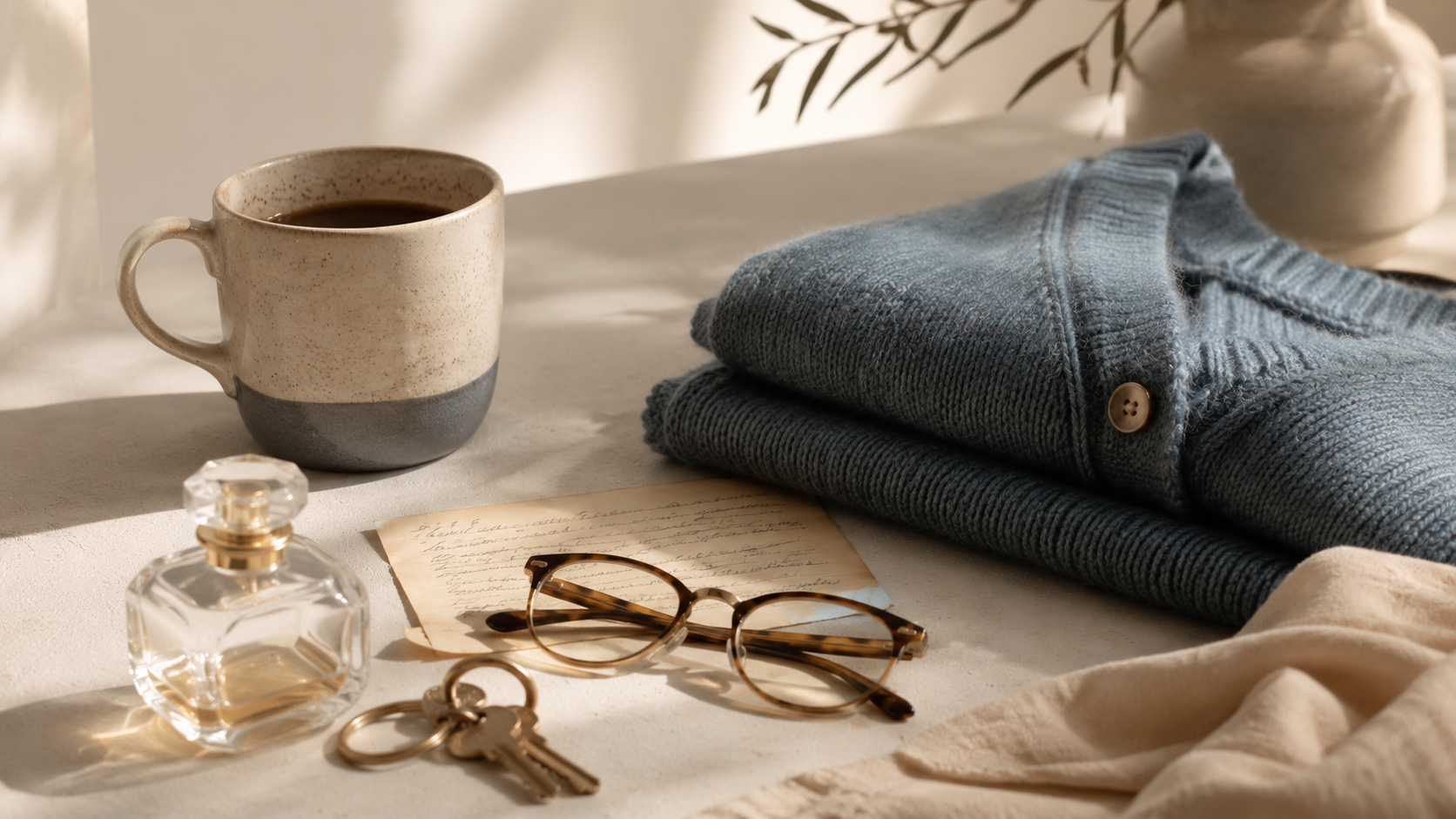
There is a mug in the cupboard that no one uses anymore.
A coat still hanging by the door.
A bottle of perfume with barely anything left in it.
A voicemail you have listened to so many times that you know the pauses between the words.
A birthday card with handwriting you would recognize anywhere.
After someone dies, ordinary things can stop feeling ordinary.
They become strangely difficult to move.
To wash.
To give away.
Sometimes even to touch.
You may know, rationally, that it is only a sweater.
And still find yourself standing in front of the closet unable to put it into a bag.
Because it isn't only a sweater.
They wore it.
Their body was inside it.
Maybe it still folds the way they folded it. Maybe, if enough time hasn't passed, it still smells like them.
And suddenly the question is no longer:
Do I need this sweater?
It is:
What does it mean if I let it go?
After someone dies, their belongings can feel different
Death has a strange way of changing objects.
The coffee cup on the counter was just a coffee cup before.
The reading glasses beside the bed were just reading glasses.
The half-used hand cream in the bathroom drawer was completely unremarkable.
Until it wasn't.
After someone dies, the smallest things can become evidence that they were here.
They drank from this.
They touched this.
They chose this ridiculous shirt.
They always left their keys in that exact spot.
Their life moved through these things.
And now it doesn't.
There can be something almost impossible about that contrast.
A person's entire physical presence is gone, and yet their shoes are still sitting by the door.
The world has changed completely.
The shoes haven't moved.
Sometimes getting rid of their things can feel like losing them again
Eventually, there may be questions about the belongings.
What should we do with the clothes?
Does anyone want the dishes?
Should we clear out the room?
The questions may be completely practical.
They can still feel brutal.
Because grief does not always experience objects practically.
Putting someone's clothes into a donation bag can feel much bigger than putting clothes into a donation bag.
Deleting a voicemail can feel different from deleting any other file.
Changing their side of the bedroom can feel like acknowledging something you have spent every morning waking up to:
They really aren't coming back.
And sometimes this is where people begin to worry about themselves.
Why can't I get rid of anything?
Why am I keeping things I don't even want?
Why am I crying over a toothbrush?
Maybe because you aren't really crying over the toothbrush.
You are grieving the person who once needed one.
The person who stood at this sink.
The person whose routines took up space in your home.
The person who existed here.
There is a difference.
The things that matter may make no sense to anyone else
Grief has very little respect for monetary value.
The jewellery may matter.
So might the handwritten grocery list.
The expensive watch may sit untouched while you become fiercely protective of an old baseball cap.
Someone may offer you the beautiful serving platter and all you really want is the chipped bowl they ate cereal from every morning.
The pen from their desk.
Their recipe cards.
A jar in the garage with their handwriting on the lid.
The last text conversation you had.
A message that simply says:
Home in ten.
These things may not look significant from the outside.
That does not mean they aren't.
Sometimes the objects we keep after someone dies hold a story no one else can see.
Sometimes what we keep lives on a phone
Not everything we hold onto lives in a box.
There are photographs.
Text threads.
Emails.
Videos where their laugh can be heard from another room.
A contact you cannot bring yourself to delete.
A phone number you still know by heart even though no one will ever answer it again.
There is something surreal about seeing a person's name in your contacts after they have died.
For a moment, they remain exactly where they always were.
One tap away.
Except they aren't.
Perhaps that is why an ordinary voicemail can become precious in a way it never was when someone was alive.
A twelve-second message asking you to pick up milk can become something you would give almost anything to hear again.
Not because of what they said.
Because of the way they said it.
The cadence.
The laugh.
The breath between sentences.
The way they said your name.
You are no longer listening for the message.
You are listening for them.
There is no right timeline for a loved one's belongings
Grief often arrives with practical responsibilities.
There are forms and phone calls and arrangements to make. Sometimes a home has to be sold. Sometimes circumstances mean possessions really do need to be sorted before you feel emotionally ready.
But when there is a choice, there does not have to be a race.
You may want to leave the closet exactly as it is.
You may need those clothes out of sight.
You may keep almost everything.
You may keep very little.
You may feel differently six months from now than you do today.
And two people grieving the same person may need completely different things.
One person's It's just stuff can collide painfully with another person's It's all I have left.
Neither tells us who loved more.
Sometimes keeping things provides comfort.
Sometimes being surrounded by them makes the absence louder.
Grief gets to be complicated like that.
You are allowed to keep things
You are allowed to keep the shirt.
The voicemail.
The birthday card.
The recipe written in their handwriting.
The mug nobody else understands why you care about.
You are allowed to decide that today is not the day you open the closet.
There is no amount of physical stuff that can measure a relationship.
And keeping something does not mean you are refusing to move forward.
Sometimes an object simply gives memory somewhere to land.
You are also allowed to let things go
This matters just as much.
Because grief can create guilt in both directions.
You may be ready to donate the clothes and wonder whether that means you did not love them enough.
You may sell the furniture.
Paint the room.
Give away the dishes.
Keep three things when everyone expected you to keep thirty.
You may discover that you don't need their belongings around you in order to feel connected to them.
That is allowed too.
Letting go of an object is not the same as letting go of a person.
Sometimes an object is deeply meaningful.
Sometimes it is simply an object that belonged to someone deeply meaningful.
Those are not quite the same thing.
Maybe the question isn't what you should keep
Maybe a gentler question is:
What feels like them?
Not what was worth the most.
Not what someone else thinks you should want.
What carries something you recognize?
The apron stained from years of Sunday dinners.
The gardening gloves.
The book with all the folded corners.
The note signed Love, Dad.
The Christmas ornament everyone teased them about.
The recipe written without measurements because apparently you were simply supposed to know what "enough flour" meant.
The sweater.
The voicemail.
The photograph that isn't particularly beautiful, except they are laughing in it.
These things cannot contain a person.
But sometimes they carry a fragment of the life you shared.
And perhaps that is why we reach for them.
Because love has always lived alongside ordinary things.
A cup of tea made the way they liked it.
A coat thrown over a chair.
A note left on the counter.
A song played too loudly in the kitchen.
A phone call on the drive home.
So when someone dies, perhaps it makes sense that grief finds us there too.
Among the ordinary things.
One day, you may open the closet.
Or you may not.
Something you cannot imagine parting with today may feel different later. Something you almost threw away may unexpectedly become precious.
There is no perfect way to make these decisions.
The things we keep are not the person.
We know that.
But sometimes, after someone dies, an ordinary object becomes a place where memory can land.
And sometimes that is reason enough to keep it.
This article is intended for general reflection and educational purposes. It is not a substitute for individualized medical or mental health care. If you are in distress or crisis, please reach out to a qualified professional or a crisis service in your area.

About the author
Registered Social Worker, Psychotherapist
Andrea O'Reilly is a grief- and trauma-informed therapist based in Oakville, Ontario, offering individual therapy across Ontario. She specializes in supporting people through grief, trauma, anxiety, and life transitions — with warmth, depth, and a deep respect for each person's story.
Meet AndreaGrief around a loved one''s belongings can be one of the quieter, lonelier parts of loss. If you are navigating this, therapy can offer a space to bring all of it — the things you are keeping, the things you cannot bring yourself to touch, and everything in between.